AI marking, with a teacher approving every mark
Piarrel proposes; the teacher decides. Each mark is proposed point by point against your own mark scheme, and nothing reaches a pupil until the teacher releases it.
What Piarrel marks, and what it leaves to you
Piarrel proposes marks for typed answers, calculations, numeric answers, multiple choice, equations and tables. Graphs, drawings and labelled diagrams are always left for the teacher to mark.
What the teacher sees
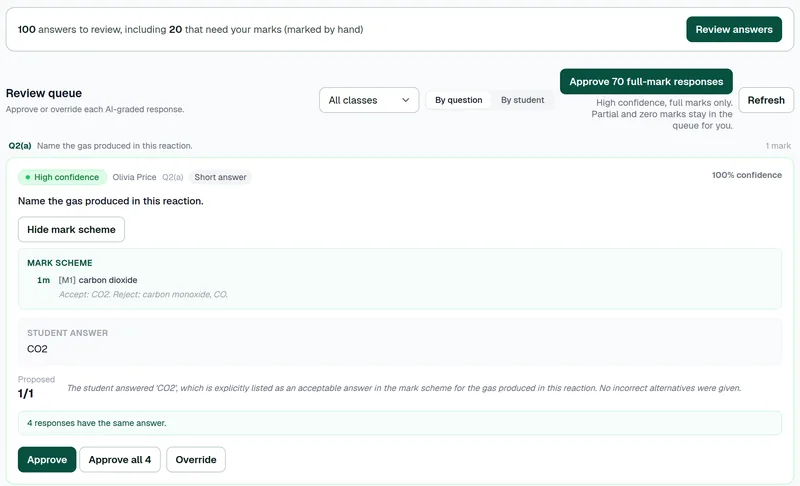
- Each answer beside the mark-scheme point and Piarrel's reasoning.
- A confidence level on every proposed mark, so the answers worth a second look stand out.
- Your conventions: accept, reject and ignore lists on every marking point.
- One press: full-marks answers proposed with high confidence approve together.
- Every decision recorded: change any mark, and the change is kept in an audit trail.

How it held up with real classes
In a September–October 2026 trial at a British international school in Spain, 3,650 of Piarrel's marks were reviewed. Teachers kept Piarrel's mark on 94.4% of reviewed answers, measured against each teacher's own final mark. Of the 203 marks teachers changed, 195 were raised and 8 lowered. Teacher time per class set was 26 minutes in Piarrel, against about 1 hour 45 minutes on paper, both timed at the school.
Feedback pupils can use
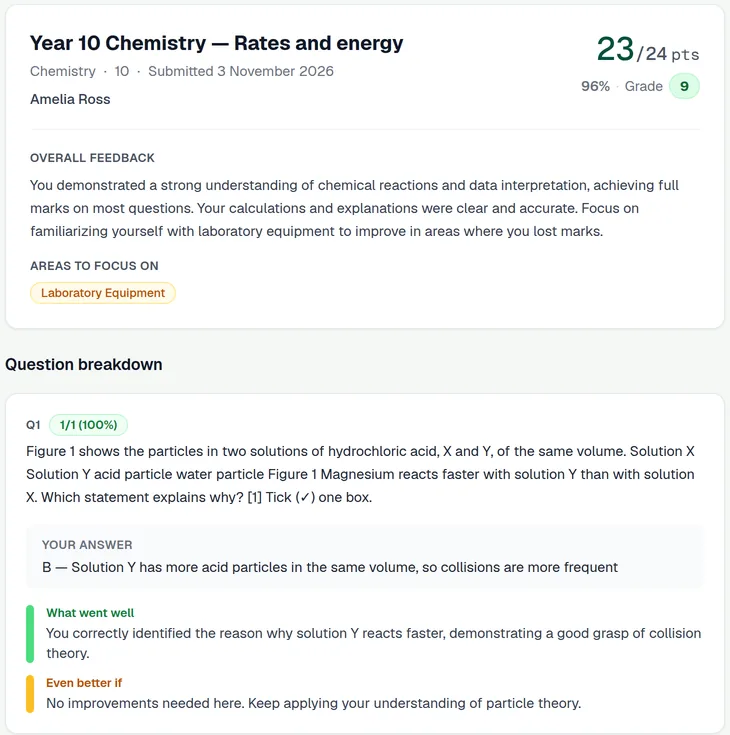
When the teacher releases the results, each pupil gets feedback written from their own answers: what went well, and what would make it even better. The class gets a summary too.
Questions
Does the AI decide pupils' marks?
No. Piarrel proposes a mark with its reasoning; a teacher approves or changes it, and only then does a pupil see it.
Who marks graphs and drawings?
The teacher, always.
Is pupils' work used to train AI?
No. Answers are marked through OpenAI's API without pupils' names, and are not used to train AI models.
Can we see why a mark was given?
Yes: every proposed mark comes with its reasoning, against the mark-scheme point it refers to.